How to Transfer Contacts Between Phones
Step-by-step guide to transferring contacts between iPhone and Android using VCF files, cloud sync, and more.
Switching to a new phone is exciting, but the thought of losing your contacts can turn that excitement into anxiety. Whether you are upgrading within the same platform or making the leap from iPhone to Android (or vice versa), transferring your contacts reliably is one of the most important steps in the process. This guide covers every major scenario and explains why VCF files remain the most dependable method for moving contacts between any two devices.
Why You Need to Transfer Contacts
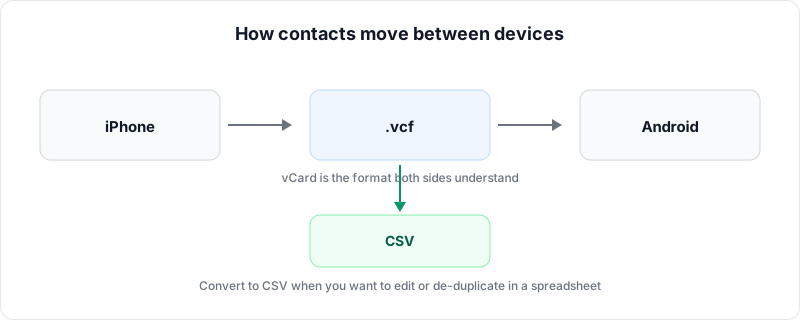
There are many reasons you might need to move contacts from one phone to another. The most common is simply upgrading to a new device. Whether you are replacing an aging phone with the latest model or switching carriers, you want all your contacts to come along without any gaps. Another increasingly common reason is switching platforms entirely, such as moving from an iPhone to an Android device or the other way around. People also transfer contacts when they set up a work phone alongside a personal one, consolidate contacts from multiple devices, or recover from a lost or damaged phone.
Regardless of the reason, the goal is always the same: get every single contact, including names, phone numbers, email addresses, and notes, from the old device to the new one without losing or corrupting any data.
Important
Always back up your contacts before starting any transfer. Export them as a VCF file and save a copy on your computer or cloud storage. If something goes wrong during the transfer, having a backup ensures you will not lose any data permanently.
iPhone to Android Transfer
Moving contacts from an iPhone to an Android phone requires exporting your contacts from Apple's ecosystem and importing them into Google's. The most reliable way to accomplish this is through VCF (vCard) files. Here is the step-by-step process:
Method 1: Export VCF from iCloud
- Enable iCloud Contacts sync on your iPhone by going to Settings, tapping your name at the top, selecting iCloud, and making sure Contacts is toggled on. Wait for your contacts to finish syncing.
- Open iCloud.com on a computer and sign in with your Apple ID. Navigate to the Contacts section.
- Select all contacts by pressing Ctrl+A (Windows) or Cmd+A (Mac). Then click the gear icon in the lower left corner and choose "Export vCard." This downloads a single VCF file containing all your contacts.
- Import on your Android phone by transferring the VCF file to your Android device via email, USB cable, or cloud storage. Open the Contacts app on your Android phone, go to Settings or Import/Export, and select "Import from .vcf file." Choose the file and your contacts will be added.
Method 2: Google Account Sync via Settings
If you already have a Google account set up on your iPhone, you can add your Google account in iPhone Settings under Mail, Contacts, Calendars (or Accounts), enable Contacts sync, and then wait for your contacts to sync to Google. Once synced, they will automatically appear on any Android device signed into that Google account.
Android to iPhone Transfer
Transferring contacts from Android to iPhone can be done through several approaches. The VCF export method remains the most reliable.
Method 1: Export VCF from Google Contacts
- Open Google Contacts at contacts.google.com on a computer while signed into the Google account used on your Android phone.
- Export your contacts by clicking the "Export" option in the left sidebar. Choose "vCard (for iOS Contacts)" as the format and click Export. This downloads a VCF file optimized for Apple devices.
- Import via iCloud by signing into iCloud.com, opening Contacts, clicking the gear icon, and selecting "Import vCard." Choose the VCF file you exported. Your contacts will sync to your iPhone through iCloud.
Method 2: Import VCF Directly on iPhone
You can also email the VCF file to yourself and open it directly on your iPhone. When you tap the attached VCF file in the Mail app, iOS offers to add all the contacts to your address book. This is quick and does not require a computer.
Method 3: Move to iOS App
Apple offers the "Move to iOS" app on the Google Play Store, which can transfer contacts, message history, photos, and more during the initial iPhone setup process. This works best when setting up a brand-new iPhone for the first time.
Android to Android Transfer
Transferring contacts between two Android devices is usually the simplest scenario, thanks to Google's built-in sync capabilities.
Google Account Sync (Easiest Method)
If your contacts are stored in your Google account (which is the default for most Android phones), simply sign into the same Google account on your new Android device. Your contacts will automatically sync within minutes. To verify your contacts are synced to Google, open the Contacts app on your old phone, tap Settings, and check that your Google account shows as the default account for new contacts.
VCF Export and Import
If your contacts are stored locally on the phone rather than in a Google account, or if you want to transfer contacts between different Google accounts, use the VCF method:
- Open the Contacts app on your old Android phone.
- Go to Settings (or Menu) and select Export. Choose to export as a .vcf file and save it to your phone's storage or share it directly.
- Transfer the VCF file to your new phone via Bluetooth, email, messaging app, or a USB cable.
- Open the Contacts app on your new phone, go to Settings, and select Import. Choose the VCF file and your contacts will be added.
iPhone to iPhone Transfer
Apple provides several seamless methods for transferring contacts between iPhones.
iCloud Sync (Easiest Method)
The simplest approach is iCloud sync. If both iPhones are signed into the same Apple ID with Contacts enabled in iCloud settings, your contacts will automatically appear on the new device. This happens in the background and requires no manual intervention beyond signing in.
AirDrop Individual VCF Files
If you need to share specific contacts rather than your entire address book, you can use AirDrop. Open the Contacts app, select a contact, tap "Share Contact," and choose AirDrop. The contact is sent as a VCF file and can be accepted on the receiving iPhone instantly. This is also useful for sharing contacts with friends and family.
Quick Start and iPhone Migration
When setting up a new iPhone, Apple's Quick Start feature lets you hold your old iPhone near the new one to transfer all data, including contacts, apps, settings, and more. This creates an exact copy of your old phone on the new device and is the most comprehensive transfer method available.
Did You Know?
VCF (vCard) is the universal standard for contact files, supported by every major platform including iOS, Android, Windows, macOS, and Linux. A single VCF file can hold one contact or thousands, making it the most portable format for transferring contacts between any two devices regardless of manufacturer or operating system.
VCF: The Universal Transfer Method
Across all the scenarios described above, one method works in every case: exporting and importing VCF (vCard) files. The VCF format is an open standard (defined by RFC 6350) that stores contact information in a structured text format. Every smartphone, email client, and contacts application can read and write VCF files.
Here is why VCF should be your go-to method for contact transfers:
- Universal compatibility — VCF files work on iOS, Android, Windows Phone, and every desktop operating system. No matter what devices you are transferring between, VCF is supported.
- Complete data preservation — VCF files can store names, phone numbers, email addresses, physical addresses, job titles, organizations, notes, photos, and custom fields. Nothing is lost in the transfer.
- Bulk or individual — You can export a single contact or your entire address book into one VCF file. This flexibility is unmatched by other transfer methods.
- Offline and independent — VCF files do not require an internet connection to create or import. You can transfer contacts via USB, Bluetooth, SD card, or any other file-sharing method.
- Inspectable — Because VCF is a text-based format, you can open the file in any text editor to see exactly what data it contains before importing. This is useful for verifying the integrity of your contacts.
How to Verify Contacts with OpenedFile
Before importing a VCF file on your new phone, it is a good idea to verify that the file contains all your contacts and that the data is correctly formatted. The OpenedFile VCF to CSV Converter lets you do exactly this, directly in your browser with no file uploads required.
- Open the converter by visiting the VCF to CSV Converter on OpenedFile.
- Drop your VCF file onto the page or use the file picker to select it. The tool parses the file entirely in your browser, so your contact data never leaves your device.
- Review the results in the table view. You can see every contact with their names, phone numbers, email addresses, and other fields displayed in an organized table. Check for missing data, formatting issues, or duplicate entries.
- Export as CSV if needed. The CSV format is useful for opening contacts in spreadsheet applications like Excel or Google Sheets, where you can search, sort, and clean up your data before importing.
Recommended
Use the OpenedFile VCF to CSV Converter to preview and verify your contacts before importing them onto a new phone. This lets you catch missing numbers, duplicate entries, or formatting errors before they become a problem. All processing happens locally in your browser, keeping your contact data private.
Troubleshooting Common Issues
Even with the best methods, contact transfers sometimes run into problems. Here are solutions to the most common issues:
Missing Contacts After Transfer
If some contacts are missing after import, check whether they were stored in a different account on your old phone. On Android, contacts may be saved to the SIM card, phone storage, or a Google account. On iPhone, contacts might be in iCloud, Gmail, or Exchange. Export from each account separately and import all VCF files onto your new device.
Duplicate Contacts
Duplicates are common when you import contacts that already exist on the new phone (for example, if Google sync and a VCF import both bring the same contacts). Most phone contact apps have a "Merge duplicates" or "Find duplicates" feature in their settings. Use this after importing to clean up any repeated entries.
Special Characters Not Displaying Correctly
If contact names with accented characters, Asian characters, or emoji appear garbled after import, the issue is usually related to character encoding. Make sure your VCF file uses UTF-8 encoding. Most modern export tools produce UTF-8 by default, but older systems may use Latin-1 or other encodings. You can verify the encoding by opening the VCF file with the OpenedFile VCF converter and checking whether names display correctly.
Contact Photos Not Transferring
Contact photos are embedded in VCF files as Base64-encoded data, which can make VCF files quite large. Some export tools strip photos to reduce file size. If your contact photos did not transfer, try exporting again with a method that preserves photos, or re-add them manually on the new device.
VCF File Will Not Open
If your phone does not recognize the VCF file, try renaming the file extension to .vcf (lowercase) and ensure the file is not corrupted. You can verify the file's integrity by opening it in the VCF to CSV Converter. If the tool can parse it successfully, the file is valid and the issue is with the importing app.
Contact transfer does not have to be stressful. With VCF files as your universal fallback and the right verification tools, you can confidently move your entire address book between any two phones without losing a single number.
Related Articles
What Is a VCF File? Complete Guide to vCard Contacts
Everything you need to know about the VCF vCard format, how it works, and how to open these files.
How to Convert VCF to CSV: A Step-by-Step Guide
Learn how to convert vCard files to CSV format for use in spreadsheets, databases, and email clients.
About the author
Ren
Developer, OpenedFile
I build and maintain OpenedFile on my own. It started when a winmail.dat attachment landed in my inbox and nothing would open it — and every online converter I found wanted me to upload the file to their server first. So I wrote a TNEF parser from scratch instead, and every tool here has run entirely in the browser ever since.
More about OpenedFile