The History and Future of Photo Formats
From BMP to AVIF — a journey through the evolution of digital image formats and what comes next.
Introduction
The story of digital image formats is a fascinating journey through nearly five decades of innovation, competition, patent disputes, and evolving technology. From the earliest bitmap files that stored every single pixel individually to modern AI-enhanced compression algorithms that can reconstruct images from remarkably little data, image formats have continuously evolved to meet the demands of new hardware, new use cases, and an ever-growing volume of digital imagery. Understanding this history helps explain why we have so many image formats today and where the technology is heading next.
The Early Days: BMP and Raw Bitmaps
The earliest digital image formats were conceptually simple. The BMP (Bitmap) format, introduced by Microsoft and IBM in the late 1980s for use in Windows and OS/2, stored images as a grid of pixel values with minimal or no compression. A 640x480 pixel image at 24-bit color depth would consume approximately 900 KB, which was enormous by the standards of the era when hard drives measured in tens of megabytes.
BMP files were straightforward to read and write, which made them useful for system graphics and application development, but their lack of compression made them impractical for storage and completely unsuitable for transmission over the slow networks of the time. Something better was needed.
GIF: Animation and the 256-Color Limit (1987)
CompuServe introduced the GIF (Graphics Interchange Format) in 1987 as a way to transmit images over its dial-up network service. GIF used LZW (Lempel-Ziv-Welch) lossless compression, which significantly reduced file sizes compared to raw bitmaps. However, GIF was limited to a maximum of 256 colors per frame, which made it unsuitable for photographs but perfectly adequate for logos, icons, and simple graphics.
GIF's most enduring feature was its support for animation. By storing multiple frames in a single file with timing information, GIF became the de facto format for simple animations on the early web. Despite numerous technically superior alternatives that have emerged over the years, animated GIFs remain popular today as a cultural phenomenon, even though they are spectacularly inefficient by modern standards.
In the 1990s, a controversy erupted when Unisys, which held the patent on LZW compression, began enforcing licensing fees on software that created GIF files. This patent dispute would directly lead to the creation of PNG.
The JPEG Revolution (1992)
The JPEG standard, published in 1992 by the Joint Photographic Experts Group, was a transformative moment in digital imaging. For the first time, there was a widely adopted format that could compress full-color photographs to a fraction of their original size with acceptable quality loss.
Did You Know?
JPEG has dominated digital photography for over 30 years since its introduction in 1992. It remains the most widely used image format in the world — a remarkable testament to the robustness of the original standard.
JPEG's compression works by converting image data from the spatial domain to the frequency domain using the Discrete Cosine Transform (DCT), then discarding high-frequency information that the human eye is less sensitive to. The degree of compression is adjustable, allowing users to choose their preferred balance between file size and image quality.
The impact of JPEG on digital photography, the internet, and visual communication cannot be overstated. It made it practical to store thousands of photos on a hard drive, send images via email, and populate web pages with photographic content. More than 30 years later, JPEG remains the most widely used image format in the world, a testament to the robustness and practicality of the original standard.
JPEG is not without limitations, however. It does not support transparency, it is limited to 8-bit color depth, and its block-based compression produces characteristic artifacts at high compression ratios. These limitations would drive the development of newer formats.
PNG Arrives: Lossless Compression and Transparency (1996)
PNG (Portable Network Graphics) was developed in 1996 as a direct response to the GIF patent controversy. It was designed to be a patent-free, lossless image format with several important improvements over GIF:
- Full color support: PNG supports up to 48-bit true color, far beyond GIF's 256-color limit
- Alpha channel transparency: Unlike GIF's binary (on/off) transparency, PNG supports variable transparency levels, enabling smooth anti-aliased edges and semi-transparent effects
- Better compression: PNG uses DEFLATE compression, which generally produces smaller files than GIF's LZW for the same content
- Lossless quality: Every pixel is preserved exactly, with no quality degradation
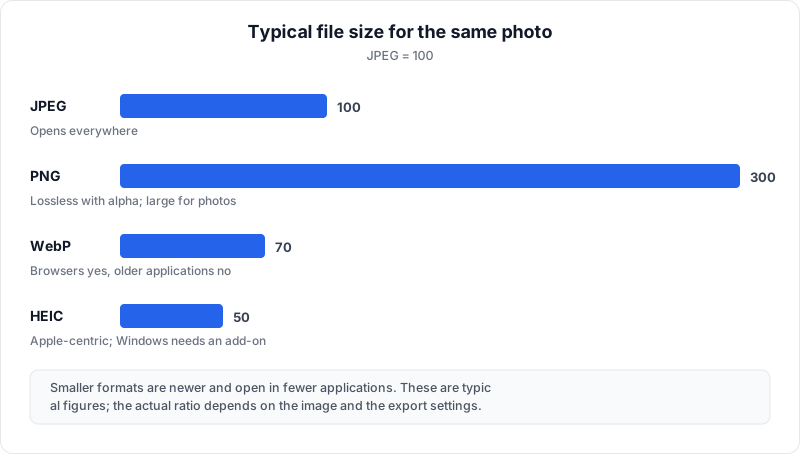
PNG became the format of choice for web graphics that required transparency or pixel-perfect reproduction, such as logos, icons, screenshots, and user interface elements. However, PNG files are significantly larger than JPEGs for photographic content because lossless compression cannot match the compression ratios that lossy algorithms achieve. This kept JPEG as the preferred format for photographs.
The Web Era: JPEG 2000 and the Failed Successors
As the internet grew and bandwidth remained limited, there was strong motivation to create better image formats. JPEG 2000, finalized in the year 2000, was the official successor to JPEG. It used wavelet-based compression instead of DCT, which eliminated the blocking artifacts of JPEG and delivered better compression efficiency.
Despite its technical superiority, JPEG 2000 failed to gain widespread adoption on the web. The reasons were both technical and practical: the codec was computationally expensive, patent licensing was complex, and browser vendors were reluctant to implement support. By the time JPEG 2000 was ready, the original JPEG was so deeply entrenched that the switching costs outweighed the benefits for most users.
JPEG 2000 did find niche success in professional applications, particularly in medical imaging and digital cinema, where its advanced features justified the computational overhead. But on the web, JPEG continued to reign.
Google's WebP (2010)
In 2010, Google introduced WebP, an image format designed specifically for the web. WebP uses compression technology derived from the VP8 video codec (which Google had acquired by purchasing On2 Technologies) and offered both lossy and lossless compression modes.
WebP's key selling point was improved compression efficiency compared to JPEG and PNG. Google claimed that lossy WebP images were 25-34% smaller than comparable JPEG images, while lossless WebP images were 26% smaller than PNG files. WebP also supported transparency and animation, making it a potential replacement for both JPEG and GIF.
Adoption was initially slow due to limited browser support. Apple's Safari was the last major browser to add WebP support, which it did not do until 2020. By the mid-2020s, however, WebP has achieved broad browser support and is widely used on the web, particularly by performance-conscious websites and content delivery networks.
Apple's HEIC/HEIF (2017)
Apple's adoption of HEIC (High Efficiency Image Container) in 2017 brought the HEIF standard into the mainstream consumer space. Based on the HEVC (H.265) video codec, HEIC offered approximately 50% better compression than JPEG while supporting advanced features like 16-bit color, transparency, depth maps, and image sequences.
HEIC's primary impact has been in the mobile photography space, where it became the default format for hundreds of millions of iPhones. Its compressed file sizes have saved enormous amounts of storage space and network bandwidth for Apple users. However, HEIC's adoption outside the Apple ecosystem has been hampered by HEVC's patent licensing complexity and the reluctance of web browsers other than Safari to implement support.
For those who need to convert HEIC files to more widely supported formats, OpenedFile provides a free browser-based HEIC converter that handles the conversion privately and efficiently.
AVIF: The Open-Source Challenger (2019)
AVIF (AV1 Image File Format) emerged in 2019 as an image format based on the AV1 video codec. AV1 was developed by the Alliance for Open Media (AOM), a consortium that includes Google, Mozilla, Amazon, Netflix, Apple, Microsoft, and other major technology companies. Crucially, AV1 is royalty-free, which eliminates the licensing barriers that have hindered HEVC's adoption.
AVIF offers compression efficiency comparable to or slightly better than HEIC, with support for HDR, wide color gamut, 12-bit color depth, transparency, and animation. Browser support has grown rapidly: Chrome, Firefox, and Edge all support AVIF, and Safari added support in 2023.
AVIF's main drawback is encoding speed. Creating AVIF files is significantly slower than encoding JPEG or even WebP, which can be a bottleneck for applications that need to process images in real time. Decoding speed is also slower than JPEG, though it is generally fast enough for practical use.
JPEG XL: The Ambitious Successor (2022)
JPEG XL is the latest format from the JPEG committee, standardized in 2022. It was designed to be the universal successor to both JPEG and PNG, combining the best features of every preceding format:
- Superior compression: Better than JPEG, WebP, and competitive with AVIF
- Lossless and lossy modes: A single format for both use cases
- Lossless JPEG recompression: Can losslessly recompress existing JPEG files to 20% smaller, and perfectly reconstruct the original JPEG
- Progressive decoding: Images load gradually from blurry to sharp, improving perceived performance
- HDR and wide gamut support: Full support for modern display technologies
- Fast encoding and decoding: Designed for practical performance, unlike AVIF's slow encoding
- Royalty-free: No licensing fees
Despite its technical merits, JPEG XL faces an uncertain future. Google controversially removed JPEG XL support from Chrome in 2023, citing insufficient ecosystem interest. Safari supports JPEG XL, and Firefox has it behind a flag. The format has strong support from the photography and creative professional communities but lacks the browser consensus needed for widespread web adoption.
Comparison Table of Image Formats
Here is a summary of how the major image formats compare across key dimensions:
- BMP: No compression, universal support, no transparency, 24-bit color. Effectively obsolete for most uses.
- GIF: Lossless (256 colors), universal support, binary transparency, supports animation. Still used for simple animations.
- JPEG: Lossy, universal support, no transparency, 8-bit color. The workhorse of digital photography.
- PNG: Lossless, universal support, alpha transparency, up to 48-bit color. Ideal for graphics and screenshots.
- WebP: Lossy and lossless, broad browser support, alpha transparency, 8-bit color, animation. Strong web format.
- HEIC: Lossy (primarily), Apple-centric support, alpha transparency, 16-bit color, depth maps. Excellent for mobile photography.
- AVIF: Lossy and lossless, growing browser support, alpha transparency, 12-bit color, HDR. Royalty-free, slow encoding.
- JPEG XL: Lossy and lossless, limited browser support, alpha transparency, up to 32-bit float, HDR, progressive. Technically superior but adoption is uncertain.
What the Future Holds
AI-Based Compression
The next frontier in image compression is artificial intelligence. Neural network-based image codecs are already demonstrating compression ratios that surpass all traditional formats. These AI codecs work by learning the statistical patterns of natural images from massive training datasets and using that knowledge to compress new images more efficiently than hand-crafted algorithms can.
Did You Know?
AI-based image codecs from companies like Google and Meta are already outperforming AVIF and JPEG XL at low bitrates. The future of image compression may rely on neural networks that learn to reconstruct images from remarkably little data.
Companies like Google, Meta, and various research institutions have published papers showing AI codecs that outperform AVIF and JPEG XL at low bitrates. However, these codecs currently require significant computational resources for both encoding and decoding, and they raise questions about how well they generalize to image types that are underrepresented in their training data.
Computational Photography Integration
Future image formats will likely need to accommodate the rich data that computational photography produces: depth maps, semantic segmentation data, multiple exposure brackets, and neural radiance fields. The container format of the future may be as much a database as a file, storing not just pixel data but the full computational context needed to reconstruct and reinterpret the scene.
Choosing the Right Format Today
With so many formats available, choosing the right one depends on your specific use case:
Recommended
For web publishing, use WebP or AVIF with JPEG fallback. For mobile photography, use HEIC on iPhone and convert to JPG for sharing. For graphics and screenshots, PNG remains the best choice. When in doubt, JPEG is still the safest format for universal compatibility.
- For web publishing: Use WebP or AVIF with JPEG fallback for maximum compatibility and performance
- For mobile photography: HEIC on iPhone, JPEG for cross-platform sharing
- For graphics and screenshots: PNG for lossless quality and transparency
- For professional photography: RAW for capture, TIFF or PNG for editing, JPEG or HEIC for delivery
- For universal sharing: JPEG remains the safest choice for maximum compatibility
When you need to convert between formats, tools like OpenedFile's image converter make it easy to switch between HEIC, JPG, and PNG without installing any software and without compromising your privacy.
Conclusion
The evolution of image formats reflects the broader arc of computing history: from simple, uncompressed representations to increasingly sophisticated algorithms that squeeze more quality from fewer bytes. Each generation of formats has addressed the limitations of its predecessors while introducing new capabilities that match the technology of its era.
Today, we live in a world where multiple image formats coexist, each optimized for different use cases. JPEG remains the universal standard, PNG dominates lossless graphics, HEIC leads mobile photography, WebP has become the web performance champion, and AVIF and JPEG XL represent the cutting edge. The future promises AI-driven compression that may eventually unify these disparate approaches, but for now, understanding the strengths and limitations of each format remains an essential skill for anyone who works with digital images.
Related Articles
HEIC vs JPG: The Complete Comparison Guide
Compare HEIC and JPG image formats — quality, file size, compatibility, and when to use each.
WebP Format Explained: Everything You Need to Know
A comprehensive guide to Google's WebP image format — features, benefits, limitations, and conversion.
WebP vs JPG vs PNG: Which Format Should You Use?
Compare the three most popular image formats and learn which one is best for your use case.
About the author
Ren
Developer, OpenedFile
I build and maintain OpenedFile on my own. It started when a winmail.dat attachment landed in my inbox and nothing would open it — and every online converter I found wanted me to upload the file to their server first. So I wrote a TNEF parser from scratch instead, and every tool here has run entirely in the browser ever since.
More about OpenedFile