Contact Management Best Practices
Practical tips for organizing, deduplicating, and backing up your digital contacts for personal and professional use.
Introduction
Your contact list is one of the most valuable digital assets you own. It connects you to friends, family, colleagues, doctors, contractors, and everyone else who matters in your daily life. Yet most people treat their contacts like a junk drawer: entries get added but rarely organized, duplicates pile up, and outdated phone numbers linger for years. When you finally need to find someone's current email address or migrate to a new phone, the mess becomes painfully obvious.
Good contact management does not require expensive software or hours of tedious work. With a handful of practical habits and the right tools, you can keep your address book clean, current, and reliably backed up. This guide walks you through the best practices for organizing, deduplicating, backing up, and syncing your digital contacts.
Why Contact Management Matters
A cluttered address book is more than an inconvenience. When you cannot quickly find the right person or the right number, you waste time, miss opportunities, and risk sending messages to the wrong recipient. For professionals, an outdated contact list can mean lost business leads. For everyone, it makes switching phones or recovering from a lost device far more stressful than it needs to be.
Beyond daily convenience, a well-maintained contact list is also a safety net. If your phone is stolen or your cloud account is compromised, having a recent offline backup means you can restore your entire network of connections in minutes rather than painstakingly rebuilding it from memory.
Did You Know?
The average smartphone user has over 500 contacts stored on their device, yet studies suggest that up to 25% of those entries contain outdated phone numbers, old email addresses, or duplicate records. Without periodic cleanup, your address book grows increasingly unreliable over time.
Organizing Contacts with Groups, Labels, and Categories
The simplest way to bring order to your contacts is to sort them into groups. Every major contact platform supports some form of grouping:
- Google Contacts uses labels. You can create custom labels like "Family," "Work," "Clients," or "Gym Friends" and assign one or more labels to each contact. Labels act as tags, so a single contact can belong to multiple groups simultaneously.
- Apple iCloud Contacts uses groups. Groups function similarly to labels but are created through the iCloud web interface or the macOS Contacts app. On iPhone, you can show or hide entire groups at once, which is useful for focusing on specific circles.
- Microsoft Outlook / Exchange uses categories and contact lists. Categories are color-coded tags that help you visually sort your address book, while contact lists (formerly distribution lists) let you email a group of people at once.
The key is to pick a grouping system and use it consistently. Even three or four broad categories, such as Personal, Work, Services, and Medical, can dramatically speed up searching and make it easy to share or export specific subsets of your contacts when needed.
Removing Duplicate Contacts
Duplicates are the most common contact management problem. They appear when you import contacts from multiple sources, sync with a new email account, or save the same person's number from different messaging apps. Over time, you end up with two or three entries for the same person, each containing slightly different information.
Built-in Deduplication Tools
Both major mobile platforms offer built-in tools for merging duplicates:
- iPhone (iOS 16 and later) — Open the Contacts app and look for the "Duplicates Found" card at the top of your contact list. iOS automatically detects contacts with matching names or phone numbers and lets you review and merge them with a single tap.
- Android (Google Contacts) — Open Google Contacts, tap "Fix & manage" at the bottom, then select "Merge duplicates." Google groups contacts that appear to be the same person and lets you merge them individually or all at once.
Export and Deduplicate Manually
For larger contact lists or more granular control, you can export your contacts as a VCF file, convert it to CSV using a tool like OpenedFile's VCF to CSV Converter, and then open the CSV in a spreadsheet application. In a spreadsheet, you can sort by name, phone number, or email to quickly spot and remove duplicates. This method also allows you to standardize formatting, such as ensuring all phone numbers use the same country code format.
Important
Before deleting any duplicate contacts, always test your sync settings first. Make sure you know which account each contact is stored in (Google, iCloud, Exchange, or device-only). If sync is active, deleting a contact on one device will remove it from all synced devices. Export a full backup as a VCF file before making any bulk deletions so you can restore contacts if something goes wrong.
Keeping Contact Info Up to Date
People change jobs, phone numbers, and email addresses more often than you might expect. A contact entry that was accurate two years ago may already be out of date. Here are some practical habits for keeping your information current:
- Update immediately — When someone gives you a new number or email, update the contact right away rather than creating a new entry. This prevents duplicates and ensures the old information is replaced.
- Review quarterly — Set a calendar reminder every three months to scan through your contacts. Delete entries you no longer need (that one-time delivery driver, the old dentist you no longer visit) and verify key details for important contacts.
- Add context notes — Most contact apps allow you to add notes to an entry. Use this field to record how you met someone, their company name, or anything else that helps you remember who they are months later.
- Use linked profiles — Google Contacts and Apple Contacts can link a contact entry to their social media or messaging profiles, which often update automatically when the person changes their information.
Regular Backup Habits
Cloud sync is convenient but it is not the same as a backup. If you accidentally delete contacts or if your account is compromised, synced deletions will propagate to all your devices immediately. A true backup is an independent copy stored separately from your active contact store.
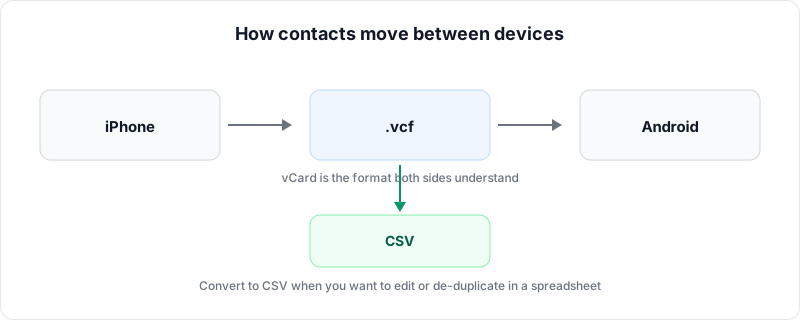
The best format for contact backups is VCF (vCard). It is a universal standard supported by every major platform, and a single VCF file can contain your entire address book. Here is a simple backup routine:
- Monthly export — Export all your contacts as a VCF file once a month. Google Contacts, iCloud, and Outlook all provide a straightforward export option.
- Name files with dates — Save each export with a filename like
contacts-2026-02-25.vcfso you can easily identify when each backup was created. - Store in multiple locations — Keep copies on your computer's hard drive and in a separate cloud storage service (like Dropbox or OneDrive) that is not the same account where your contacts are actively synced.
Choosing a Primary Contact Store
One of the biggest sources of contact chaos is having entries scattered across multiple accounts. Your phone might be syncing contacts from Google, iCloud, and an Exchange work account simultaneously, leading to duplicates and confusion about where the "real" copy of each contact lives.
The solution is to choose a single primary contact store and funnel all your contacts into it:
- Google Contacts — Best if you use Android devices or rely heavily on Gmail. Google Contacts works across all platforms via the web and offers excellent search, label management, and automatic duplicate detection.
- Apple iCloud — Best if you are fully invested in the Apple ecosystem (iPhone, iPad, Mac). iCloud contacts sync seamlessly across all Apple devices and integrate tightly with FaceTime, iMessage, and Mail.
- Microsoft Exchange / Microsoft 365 — Best for professional environments where your organization manages email and contacts through Exchange. Outlook's contact management integrates deeply with calendar scheduling and email workflows.
Once you have chosen a primary store, migrate all device-only contacts and contacts from secondary accounts into it. Then disable contact sync for the secondary accounts to prevent future duplicates.
Syncing Contacts Across Devices
After consolidating your contacts into a primary store, syncing becomes straightforward. Add your primary account (Google, iCloud, or Exchange) to every device you use and enable contact sync. Changes made on any device will propagate to all others within minutes.
A few tips for reliable syncing:
- Check the default account for new contacts — On both iOS and Android, you can choose which account new contacts are saved to by default. Make sure this is set to your primary store so new entries do not end up in a device-only or secondary account.
- Verify sync is active after OS updates — Major operating system updates occasionally reset sync preferences. After updating your phone or computer, confirm that contact sync is still enabled for your primary account.
- Use CardDAV for cross-platform sync — If your primary store is iCloud but you also use an Android device, you can add your iCloud account to Android using the CardDAV protocol. Similarly, Google Contacts can be synced to Apple devices via CardDAV. This ensures full cross-platform compatibility without duplicating data.
Using VCF for Portable Backups
The VCF (vCard) format is the gold standard for portable contact backups. Unlike platform-specific export formats, VCF files can be imported into virtually any contact application on any operating system. A single .vcf file can hold one contact or thousands, making it ideal for both individual sharing and full address book backups.
VCF files store structured data including names, phone numbers, email addresses, physical addresses, job titles, organizations, birthdays, and even photos. Because the format is plain text at its core, VCF files are compact, easy to store, and will remain readable for decades regardless of what platforms or software evolve in the future.
To learn more about the VCF format and its capabilities, see our detailed guide on what a VCF file is and how to open it.
Converting to CSV for Bulk Review and Cleanup
While VCF is the best format for storing and transferring contacts, CSV (comma-separated values) is far better for reviewing and editing contacts in bulk. A CSV file opens in any spreadsheet application, such as Google Sheets, Microsoft Excel, or LibreOffice Calc, where you can sort, filter, search, and edit hundreds of contacts at once.
The workflow is simple:
- Export your contacts as a VCF file from your primary contact store.
- Convert the VCF to CSV using OpenedFile's VCF to CSV Converter. The tool runs entirely in your browser, so your contact data never leaves your device.
- Open the CSV in your preferred spreadsheet application.
- Review and clean — Sort by name to find duplicates, filter by empty fields to find incomplete entries, and standardize phone number formats across all rows.
- Save the cleaned CSV and, if needed, convert it back to VCF for re-importing into your contact application.
This approach is particularly powerful for large contact lists where scrolling through entries one by one in a phone app would take hours. A spreadsheet lets you process hundreds of contacts in minutes with familiar tools like find-and-replace, conditional formatting, and column sorting. For a step-by-step walkthrough of the conversion process, see our VCF to CSV conversion guide.
Recommended
Export your contacts as a VCF file regularly and use OpenedFile's VCF to CSV Converter to transform them into a spreadsheet-friendly format. This makes it easy to review, deduplicate, and clean up your entire address book in one session. Since the conversion happens locally in your browser, your private contact data is never uploaded to any server.
Conclusion
Effective contact management comes down to a few consistent habits: choose one primary contact store and stick with it, organize entries into groups or labels, remove duplicates regularly, and maintain offline backups in the universal VCF format. When your contact list needs a deep clean, converting a VCF export to CSV gives you the spreadsheet power to sort, filter, and fix hundreds of entries in minutes.
The time you invest in maintaining your contacts pays off every time you switch phones, recover from a device failure, or simply need to find the right person's current information quickly. Start with a single export and review session today, and you will be surprised how much cleaner and more useful your address book becomes.
Related Articles
What Is a VCF File and How Do You Open It?
Learn about the vCard format, what data it stores, and how to open VCF files on any device.
How to Transfer Contacts Between Phones
Step-by-step methods for moving contacts between iPhone and Android devices.
VCF to CSV Conversion Guide
A complete walkthrough for converting vCard files to spreadsheet-friendly CSV format.
About the author
Ren
Developer, OpenedFile
I build and maintain OpenedFile on my own. It started when a winmail.dat attachment landed in my inbox and nothing would open it — and every online converter I found wanted me to upload the file to their server first. So I wrote a TNEF parser from scratch instead, and every tool here has run entirely in the browser ever since.
More about OpenedFile